Saturday, August 10, 2024

Akeldama: A Theological Analysis of the Field of Blood and Its Biblical Significance


The narrative of Judas Iscariot's betrayal of Jesus Christ stands as one of the most poignant and theologically rich episodes in the New Testament. Within this narrative, a seemingly insignificant plot of land known as Akeldama emerges as a powerful symbol of betrayal, divine justice, and the far-reaching consequences of human choices. This blog post aims to provide a comprehensive theological analysis of Akeldama, exploring its significance within the broader context of Biblical theology, particularly from an evangelical perspective.


Our journey will begin by closely examining the primary Biblical passage introducing us to Akeldama: Acts 1:18-19. From there, we will expand our investigation to consider the relationship between Akeldama and other significant Biblical locations and concepts, including Gehinnom and the "valley of death" mentioned in the Psalms. We will draw upon various associated scriptures throughout our exploration to deepen our understanding and enrich our theological reflections.


As we embark on this scholarly endeavor, it is important to note that our analysis will be grounded in the English Standard Version of the Bible. This translation, known for its accuracy and readability, will serve as our primary textual source for quotations and references. We aim to maintain consistency and clarity throughout our discussion by adhering to a single translation.


I. Akeldama in Acts 1:18-19: Textual Analysis and Immediate Context


We begin our exploration with a close reading of the primary scriptural passage that introduces us to Akeldama:


"Now this man acquired a field with the reward of his wickedness, and falling headlong he burst open in the middle and all his bowels gushed out. And it became known to all the inhabitants of Jerusalem, so that the field was called in their own language Akeldama, that is, Field of Blood." (Acts 1:18-19, ESV)


A. Linguistic Considerations


1. Akeldama (Ἁκελδαμά): This Aramaic term, transliterated into Greek in the original text, carries profound significance. Its literal meaning, "Field of Blood," encapsulates this location's grim history and spiritual implications.


2. "Reward of his wickedness" (μισθοῦ τῆς ἀδικίας): This phrase emphasizes the causal relationship between Judas's betrayal and the acquisition of the field. The term "μισθοῦ" (misthou) typically denotes wages or rewards, underscoring the transactional nature of Judas's actions.


B. Narrative Context


The account of Akeldama appears within a broader narrative framework in Acts 1. Following Jesus' ascension, the apostles gather to select a replacement for Judas. Addressing the group, Peter recounts Judas's fate as a prelude to this selection process. This contextual placement serves several purposes:


1. It provides closure to the Judas narrative, which is left unresolved in the Gospels.

2. It demonstrates the fulfillment of Old Testament prophecies regarding the betrayer's fate (cf. Psalms 69:25; 109:8).

3. It establishes a theological foundation for the reconstitution of the Twelve, emphasizing the continuity of God's redemptive plan despite human failings.


C. Theological Implications


1. Divine Sovereignty and Human Responsibility: The account of Akeldama presents a complex interplay between divine sovereignty and human free will. While Judas's actions were foreknown and even prophesied, the Bible presents him as fully responsible for his choices.


2. The Wages of Sin: Akeldama serves as a stark reminder of the consequences of sin. The graphic description of Judas's death and the permanent marking of the land as a "Field of Blood" underscore the severe ramifications of betraying the Son of God.


3. Redemptive Irony: There is a profound irony in the blood money intended to lead to Jesus' death instead purchases a burial ground. This irony can be seen as a divine subversion of evil intentions, pointing towards the ultimate redemptive purpose of Christ's death.


II. Akeldama and Gehinnom: Theological Connections


Having examined the immediate context of Akeldama in Acts, we now focus on its relationship with Gehinnom, another significant location in Biblical theology. While not explicitly linked in Scripture, these two sites share meaningful thematic and theological connections that warrant exploration.


A. Gehinnom: An Overview


Gehinnom, or the Valley of Hinnom, is a ravine located south and southwest of Jerusalem. Its significance in Biblical and post-Biblical tradition is multifaceted:


1. Historical Context: In Old Testament times, this valley was associated with pagan worship, particularly the practice of child sacrifice to the god Molech (2 Kings 23:10; Jeremiah 32:35).


2. Prophetic Judgment: The prophets denounced these practices and proclaimed God's judgment upon the valley (Jeremiah 7:30-34; 19:1-13).


3. Eschatological Symbolism: By the time of the New Testament, Gehinnom (Gehenna in Greek) had become a metaphor for divine punishment and the final judgment of the wicked.


B. Thematic Parallels between Akeldama and Gehinnom


1. Blood and Death: Both locations are intimately associated with death and bloodshed. Akeldama, as the "Field of Blood," carries this connection in its very name, while Gehinnom's history of child sacrifice imbues it with similar connotations.


2. Divine Judgment: Both sites serve as powerful symbols of God's judgment against sin. Judas's fate and Akeldama's name reflect divine retribution, paralleling the prophetic judgments pronounced upon Gehinnom.


3. Perpetual Memorial: Just as Gehinnom became a lasting symbol of judgment in Jewish and Christian thought, Akeldama is a permanent reminder of betrayal and its consequences.


C. Theological Reflections


1. The Geography of Judgment: Akeldama and Gehinnom demonstrate how physical locations can become imbued with profound spiritual significance. They serve as tangible reminders of abstract theological truths, anchoring divine judgment in the landscape of human experience.


2. From Temporal to Eternal: While both sites are earthly locations, they point towards eternal realities. Gehinnom's transformation from a physical valley to a symbol of final judgment parallels how Akeldama transcends its status as a mere field to become a lasting testament to the spiritual consequences of betrayal.


3. Redemptive Possibility: Despite their grim associations, both locations hint at the possibility of redemption. Jeremiah's prophecy of restoration for the Valley of Hinnom (Jeremiah 31:40) and the use of Akeldama as a burial ground for foreigners suggest that even places marked by sin can be reclaimed for redemptive purposes.


III. Akeldama and the "Valley of Death": Psalmic Connections


Having explored the relationship between Akeldama and Gehinnom, we now focus on another significant Biblical motif: the "valley of death" in the Psalms. While this phrase is most famously associated with Psalm 23, its thematic resonances extend beyond a single passage and offer rich insights when considered in relation to Akeldama.


A. The "Valley of Death" in Psalmic Literature


1. Psalm 23:4 (ESV): "Even though I walk through the valley of the shadow of death, I will fear no evil, for you are with me; your rod and your staff, they comfort me."


2. Psalm 44:19 (ESV): "Yet you have broken us in the place of jackals and covered us with the shadow of death."


3. Psalm 107:10-14 (ESV): "Some sat in darkness and in the shadow of death, prisoners in affliction and in irons... Then they cried to the Lord in their trouble, and he delivered them from their distress. He brought them out of darkness and the shadow of death, and burst their bonds apart."


B. Thematic Parallels with Akeldama


1. Death and Darkness: Both the "Valley of Death" and Akeldama are associated with mortality and the darker aspects of human experience. Akeldama, as a burial ground purchased with blood money, embodies the finality of death and the consequences of sin.


2. Divine Presence amid Suffering: While Psalm 23 emphasizes God's comforting presence in the valley of death, Akeldama presents a contrasting picture of divine absence or judgment. This juxtaposition invites reflection on the nature of God's presence in places of darkness and despair.


3. Redemption and Deliverance: Psalm 107 speaks of God delivering people from the shadow of death. While Akeldama itself is not explicitly redeemed in Scripture, its use as a burial ground for foreigners hints at a redemptive purpose emerging from tragic circumstances.


C. Theological Reflections


1. The Universality of Human Mortality: The Psalmic "Valley of Death" and Akeldama remind us of the universal human experience of mortality. They confront us with the reality of death and invite theological reflection on its meaning and significance in light of God's redemptive purposes.


2. Divine Sovereignty over Death: The Psalms consistently affirm God's power over death and darkness. When viewed through this lens, even Akeldama - a place seemingly marked by divine judgment - can be seen as ultimately subject to God's sovereign purposes.


3. The Journey of Faith: The "valley of death" in Psalm 23 is presented as a place through which the believer passes, not a final destination. This perspective challenges us to view Akeldama not merely as a symbol of judgment but as part of a larger narrative of faith, struggle, and ultimate redemption.


4. Comfort in Desolate Places: The Psalmist's assertion of God's comforting presence in the valley of death provides a powerful counterpoint to the seeming desolation of Akeldama. It invites us to consider how divine comfort might be experienced or manifested even in places marked by betrayal and judgment.


IV. Akeldama in the Context of Biblical Blood Theology


The designation of Akeldama as the "Field of Blood" invites a deeper exploration of blood theology in Scripture. This rich vein of Biblical teaching provides crucial context for understanding the full theological significance of Akeldama.


A. Old Testament Foundations


1. Life in the Blood: "For the life of the flesh is in the blood, and I have given it for you on the altar to make atonement for your souls, for it is the blood that makes atonement by the life." (Leviticus 17:11, ESV)


2. Blood Crying Out: "And the Lord said, 'What have you done? The voice of your brother's blood is crying to me from the ground.'" (Genesis 4:10, ESV)


3. Blood Guilt: "You shall not pollute the land in which you live, for blood pollutes the land, and no atonement can be made for the land for the blood that is shed in it, except by the blood of the one who shed it." (Numbers 35:33, ESV)


B. New Testament Fulfillment


1. Redemption through Christ's Blood: "In him we have redemption through his blood, the forgiveness of our trespasses, according to the riches of his grace" (Ephesians 1:7, ESV)


2. Peace through the Cross: "And through him to reconcile to himself all things, whether on earth or in heaven, making peace by the blood of his cross." (Colossians 1:20, ESV)


3. Cleansing from Sin: "But if we walk in the light, as he is in the light, we have fellowship with one another, and the blood of Jesus his Son cleanses us from all sin." (1 John 1:7, ESV)


C. Akeldama in Light of Biblical Blood Theology


1. Blood Money and Guilt: The designation of Akeldama as the "Field of Blood" emphasizes the blood guilt associated with Judas's betrayal. This emphasis resonates with the Old Testament concept of blood polluting the land (Numbers 35:33), suggesting that the field bears the stain of Judas's sin.


2. Ironies of Redemption: While Judas's "blood money" led to death, it starkly contrasts the redemptive power of Christ's blood. This juxtaposition highlights the transformative nature of Christ's sacrifice.


3. Cry of the Innocent: Just as Abel's blood cried out from the ground (Genesis 4:10), Akeldama serves as a perpetual witness to the betrayal of innocent blood. However, where Abel's blood cried for vengeance, Christ's blood speaks "a better word than the blood of Abel" (Hebrews 12:24, ESV), offering forgiveness and reconciliation.


4. Atonement and Cleansing: The use of Akeldama as a burial ground for foreigners hints at a redemptive purpose. This redemptive purpose can be seen as a faint echo of the cleansing power of Christ's blood, which extends to people from all nations.


D. Theological Reflections


1. The Cost of Betrayal: Akeldama starkly reminds us of the high cost of betraying Christ. It challenges believers to consider sin's seriousness and faithfulness's importance.


2. Grace Amidst Judgment: While Akeldama primarily symbolizes judgment, its repurposing as a burial ground suggests the possibility of grace emerging from even the darkest circumstances.


3. The Sufficiency of Christ's Blood: The stark contrast between the "blood money" of Akeldama and the redemptive blood of Christ emphasizes the utter sufficiency of Christ's sacrifice to atone for all sin, even betrayal.


4. Ongoing Witness: Just as Akeldama became a lasting testament to Judas's betrayal, believers are called to be ongoing witnesses to the redemptive power of Christ's blood in their lives and communities.


V. Akeldama and the Theology of Place in Scripture


The story of Akeldama invites us to consider the broader theology of place in Scripture. Throughout the Bible, physical locations become imbued with spiritual significance, serving as tangible reminders of God's actions in history and His ongoing engagement with humanity.


A. Biblical Precedents for Sacred Spaces


1. Bethel: "And he called the name of that place Bethel, but the name of the city was Luz at the first." (Genesis 28:19, ESV) Jacob's encounter with God transforms an ordinary location into a "house of God."


2. Mount Sinai: "And Moses went up on the mountain, and the cloud covered the mountain. The glory of the Lord dwelt on Mount Sinai, and the cloud covered it six days." (Exodus 24:15-16, ESV) The mountain becomes a place of divine revelation and covenant-making.


3. Jerusalem: "But I have chosen Jerusalem that my name may be there, and I have chosen David to be over my people Israel." (2 Chronicles 6:6, ESV) The city becomes the center of worship and the symbol of God's presence among His people.


B. Akeldama as a Spiritually Significant Location


1. Witness to Betrayal: Like the stone Jacob set up at Bethel, Akeldama stands as a permanent witness to a significant spiritual event—in this case, Christ's betrayal.


2. Place of Judgment: Like Mount Sinai became associated with God's holiness and judgment, Akeldama is a stark reminder of divine justice.


3. Redemptive Repurposing: Just as God chose Jerusalem for His name to dwell there, the repurposing of Akeldama as a burial ground for foreigners hints at a redemptive intention emerging from tragic circumstances.


C. Theological Implications


1. The Incarnational Principle: The significance of Akeldama reflects the broader Biblical theme of God's engagement with physical reality. Just as the Word became flesh in the Incarnation, spiritual truths are often embodied in physical locations.


2. Remembrance and Warning: Sacred spaces in Scripture often serve as memorials, helping God's people remember key events in salvation history. Akeldama functions similarly as a perpetual warning against the dangers of betrayal.


3. Transformation of the Mundane: The story of Akeldama demonstrates how ordinary places can become extraordinarily significant in light of their spiritual history. This challenges believers to be attentive to God's work in seemingly unremarkable aspects of life.


4. Tension between Holiness and Defilement: While many sacred spaces in Scripture are associated with God's holiness, Akeldama presents the opposite - a place marked by sin and judgment. This tension invites reflection on how God works to accomplish His purposes, even through morally ambiguous or adverse events.


5. Localization and Universalization: Akeldama's specific physical location in Jerusalem paradoxically serves to universalize its message. It becomes a symbol that transcends its geographical boundaries, speaking to all believers about the consequences of betrayal and the complexity of God's redemptive work.


VI. Akeldama and the Narrative of Judas: A Theological Reflection


The story of Akeldama is inextricably linked with Judas Iscariot's narrative. A thorough theological analysis must, therefore, consider how this location fits into the broader theological themes surrounding Judas's betrayal and its aftermath.


A. The Betrayal Narrative in the Gospels


1. Predestination and Free Will: "For the Son of Man goes as it has been determined, but woe to that man by whom he is betrayed!" (Luke 22:22, ESV)


2. The Role of Satan: "Then Satan entered into Judas called Iscariot, who was of the number of the twelve." (Luke 22:3, ESV)


3. Remorse and Despair: "Then when Judas, his betrayer, saw that Jesus was condemned, he changed his mind and returned the thirty pieces of silver to the chief priests and the elders, saying, 'I have sinned by betraying innocent blood.' They said, 'What is that to us? See to it yourself.'" (Matthew 27:3-4, ESV)


B. Akeldama as the Culmination of Judas's Story


1. Divine Judgment: The gruesome description of Judas's death in Acts 1:18 and the naming of Akeldama suggest a form of divine judgment on the betrayer.


2. Fulfillment of Prophecy: "For it is written in the Book of Psalms, 'May his camp become desolate, and let there be no one to dwell in it'; and 'Let another take his office.'" (Acts 1:20, ESV, quoting Psalm 69:25 and Psalm 109:8)


3. Perpetual Memorial: The field's renaming as Akeldama ensures that Judas's betrayal becomes a lasting part of Christian history.


C. Theological Reflections


1. The Nature of Betrayal: Akeldama powerfully symbolizes the ultimate consequences of betraying Christ. It challenges believers to examine their own faithfulness and the seriousness of spiritual betrayal.


2. Despair vs. Repentance: Judas's remorse, which led to the purchase of Akeldama, starkly contrasts Peter's repentance after his denial. This juxtaposition invites reflection on the nature of true repentance and the danger of despair.


3. The Complexity of Divine Providence: The Akeldama narrative highlights the intricate interplay between human choices and divine foreknowledge. It challenges simplistic understandings of predestination and free will.


4. The Limits of Blood Money: The chief priests' inability to put the returned silver into the treasury (Matthew 27:6) and its subsequent use to buy Akeldama highlight the moral taint of ill-gotten gains. This aligns with broader Biblical teachings on the proper use of wealth and the dangers of greed.


5. From Tragedy to Redemption: While Akeldama originates in a tragic betrayal, its use as a burial ground for foreigners hints at a redemptive purpose. This view reflects the broader Biblical theme of God bringing good out of evil circumstances (cf. Genesis 50:20).


VII. Akeldama and Eschatological Themes


While Akeldama is primarily associated with past events, its symbolic significance extends into eschatological themes present in Scripture. This section explores how the concept of Akeldama intersects with Biblical teachings about the final judgment and the end times.


A. Akeldama and Final Judgment


1. The Day of the Lord: "But the day of the Lord will come like a thief, and then the heavens will pass away with a roar, and the heavenly bodies will be burned up and dissolved, and the earth and the works that are done on it will be exposed." (2 Peter 3:10, ESV)


2. The Great White Throne: "Then I saw a great white throne and him who was seated on it. From his presence earth and sky fled away, and no place was found for them." (Revelation 20:11, ESV)


B. Thematic Connections


1. Blood and Judgment: The association of Akeldama with blood resonates with apocalyptic imagery in Revelation: "From the winery of God's wrath... blood flowed... as high as a horse's bridle" (Revelation 14:19-20, ESV).


2. Permanence of Consequences: Just as Akeldama stands as a lasting reminder of Judas's betrayal, the final judgment establishes the permanent consequences of one's relationship with Christ.


3. Burial and Resurrection: Akeldama's function as a burial ground connects with the Biblical teaching on bodily resurrection and the final judgment: "And many of those who sleep in the dust of the earth shall awake, some to everlasting life, and some to shame and everlasting contempt." (Daniel 12:2, ESV)


C. Theological Reflections


1. Present Actions, Eternal Consequences: Akeldama powerfully reminds us that present actions can have eternal consequences, reinforcing the New Testament's emphasis on the eschatological significance of current choices.


2. Divine Justice and Mercy: The complex narrative of Akeldama—encompassing both judgment on Judas and provision for foreigners—mirrors the Biblical portrayal of the final judgment as a manifestation of divine justice and mercy.


3. The Finality of Judgment: The permanence of Akeldama's name and reputation parallels the finality of God's eschatological judgment, challenging believers to live in light of this ultimate reality.


4. Redemption of Creation: While Akeldama represents a place marked by sin, its repurposing hints at the broader Biblical theme of creation's ultimate redemption: "For the creation waits with eager longing for the revealing of the sons of God." (Romans 8:19, ESV)


VIII. Akeldama in Christian Tradition and Practice


Beyond its Biblical significance, Akeldama has been a part of Christian tradition and practice throughout history. This section explores how the concept has been understood and applied in various Christian contexts.


A. Early Church and Patristic Interpretations


1. Symbolic Readings: Many Church Fathers saw Akeldama as a symbol of the consequences of betraying Christ, using it as a warning against apostasy.


2. Typological Interpretations: Some patristic writers drew typological connections between Akeldama and Old Testament themes, seeing them as fulfilling prophetic judgments.


B. Medieval and Reformation Perspectives


1. Pilgrimage Site: During the medieval period, Akeldama became a pilgrimage site, with a charnel house built on the traditional location.


2. Reformation Critique: Reformers often used the Akeldama narrative to critique ecclesiastical corruption, likening the sale of indulgences to Judas's blood money.


C. Modern Applications and Interpretations


1. Ethical Reflections: Contemporary theologians have used the Akeldama narrative to reflect on ethical issues related to blood money, corruption, and the consequences of betrayal.


2. Psychological Readings: Some modern interpreters have explored the psychological dimensions of Judas's betrayal and its culmination in Akeldama, considering themes of guilt, remorse, and despair.


D. Theological Reflections


1. The Danger of Historicization: Focusing on Akeldama as a physical location risks reducing its theological significance to mere historical curiosity. A balanced approach recognizes both its historical reality and its ongoing symbolic importance.


2. Contextualization of Sin and Redemption: The varied interpretations of Akeldama throughout Christian history demonstrate the need to continually recontextualize Biblical narratives, applying their lessons to contemporary situations.


3. The Power of Symbolic Spaces: The enduring fascination with Akeldama highlights the human need for tangible connections to spiritual realities, a theme that runs throughout Biblical and church history.


4. Warning and Hope: Akeldama's dual nature—as both a warning against betrayal and a sign of potential redemption—encapsulates the Biblical balance between divine judgment and mercy.


IX. Conclusion: Akeldama and the Gospel Narrative


As we conclude our theological analysis of Akeldama, it is crucial to situate this potent symbol within the broader narrative of the Gospel. While Akeldama emerges from one of the darkest moments in the passion narrative, its significance ultimately points us back to the central themes of Christ's redemptive work.


A. Recapitulation of Key Themes


1. Divine Sovereignty and Human Responsibility: The Akeldama narrative encapsulates the Biblical tension between God's sovereign plan and human free will.


2. The Wages of Sin: Akeldama starkly reminds us of the consequences of sin, particularly the grievous sin of betraying Christ.


3. From Judgment to Redemption: The repurposing of Akeldama hints at the possibility of redemption emerging from even the most tragic circumstances.


4. The Theology of Place: Akeldama exemplifies how physical locations can become imbued with profound spiritual significance in the Biblical narrative.


B. Akeldama and the Cross


1. Contrasting Bloodshed: The blood money that purchased Akeldama stands in sharp contrast to the redemptive blood shed by Christ on the cross.


2. Despair and Hope: Where Akeldama represents the despair of Judas, the cross offers hope to all who trust in Christ's atoning work.


3. Divine Reversal: Just as God brought a measure of redemption to Akeldama through its use as a burial ground, the cross represents the ultimate divine reversal, turning an instrument of execution into the means of salvation.


C. Pastoral and Practical Implications


1. The Call to Faithfulness: Akeldama is a powerful warning against the dangers of betrayal, calling believers to remain faithful to Christ.


2. The Offer of Redemption: Even in the face of grievous sin, the Gospel holds out the hope of forgiveness and restoration to all who genuinely repent.


3. Dealing with Guilt and Shame: The contrast between Judas's despair and Peter's restoration offers valuable lessons on handling guilt and receiving God's forgiveness.


4. Stewardship of Resources: The narrative surrounding Akeldama challenges believers to consider how they use their financial resources in light of Kingdom values.


D. Final Reflections


In the end, Akeldama stands as a complex symbol within the Biblical narrative - a place of judgment and a sign of potential redemption, a warning against betrayal, and a testimony to the far-reaching consequences of the crucifixion. It reminds us that the Gospel story encompasses the full range of human experience, from the depths of betrayal to the heights of divine love.


As we contemplate Akeldama, we are drawn back to the central message of the New Testament: that in Christ, God has acted decisively to address the problem of human sin and betrayal. The very existence of Akeldama in scripture serves not primarily to focus our attention on Judas but to highlight the redemptive work of the One he betrayed.


In this light, Akeldama becomes more than a "Field of Blood"—it becomes a signpost pointing us to the One whose blood truly cleanses from all sin. It challenges us to consider our own response to the Gospel, examine our faithfulness, and marvel at the redemptive power of God that can bring light out of darkness and life out of death.


As we close this theological exploration, may the story of Akeldama serve not as a mere historical curiosity but as a compelling reminder of our need for Christ and the transformative power of His grace. In every field of blood in our world and our lives, may we see the possibility of redemption through the One who gives beauty for ashes and the oil of joy for mourning (Isaiah 61:3).


Friday, August 9, 2024

Pursuing Peace: A Theological Exploration of Harmony Among Believers


The Biblical call to peace, a beacon of hope and a challenge to the Christian community, is a topic of significant importance. This exploration delves into the theological foundations and practical implications of pursuing peace with one another, as outlined in the apostle Paul's writings to the Romans and Ephesians. Our journey will take us through the corridors of biblical exegesis, theological reflection, and practical application, all aiming to understand and embody the peace that Christ calls us to cultivate.

The concept of peace, or שָׁלוֹם 'shalom' in Hebrew, extends far beyond the mere absence of conflict. It encompasses a state of wholeness, completeness, and harmonious relationships—with God, with others, and within oneself. As we embark on this theological odyssey, we will unpack the rich tapestry of Biblical teaching on peace, focusing particularly on Romans 12:18-21 and Ephesians 4:1-6 while drawing connections to the broader Biblical instructions.

I. The Biblical Mandate for Peace

Let us begin by examining the apostle Paul's exhortation in Romans 12:18-21 (ESV):

"If possible, so far as it depends on you, live peaceably with all. Beloved, never avenge yourselves, but leave it to the wrath of God, for it is written, 'Vengeance is mine, I will repay, says the Lord.' To the contrary, 'if your enemy is hungry, feed him; if he is thirsty, give him something to drink; for by so doing you will heap burning coals on his head.' Do not be overcome by evil, but overcome evil with good."

This passage presents a radical ethic of peace that challenges our natural inclinations and cultural norms. Paul's instruction to "live peaceably with all" is not a mere suggestion but a divine imperative. The qualifier "if possible, so far as it depends on you" acknowledges that peace is not always achievable. Still, it places the responsibility squarely on the believer to pursue it diligently.

The command to forsake vengeance and leave judgment to God (Romans 12:19) strikes at the heart of human pride and the desire for retribution. By quoting Deuteronomy 32:35, Paul grounds this teaching in the Old Testament, demonstrating continuity between God's character and expectations across both covenants. The imagery of feeding and giving drink to one's enemy (Romans 12:20) echoes Proverbs 25:21-22, illustrating that pursuing peace often requires counterintuitive and sacrificial actions.

The metaphor of heaping 'burning coals' on the enemy's head, a subject of much scholarly debate, can be clarified. Some interpret it as a means of inducing shame or remorse in the adversary, while others see it as a symbol of God's judgment. However, in the context of overcoming evil with good (Romans 12:21), it is more likely that Paul intends this as a vivid illustration of how acts of kindness can transform enmity into reconciliation.

Turning to Ephesians 4:1-6 (ESV), we find a complementary perspective on peace within the body of Christ:

"I therefore, a prisoner for the Lord, urge you to walk in a manner worthy of the calling to which you have been called, with all humility and gentleness, with patience, bearing with one another in love, eager to maintain the unity of the Spirit in the bond of peace. There is one body and one Spirit—just as you were called to the one hope that belongs to your call—one Lord, one faith, one baptism, one God and Father of all, who is over all and through all and in all."

Here, Paul frames the pursuit of peace within the context of the believer's calling and the unity of the Church. The virtues he enumerates—humility, gentleness, patience, and forbearance—are the building blocks of peaceful relationships. The appeal to be "eager to maintain the unity of the Spirit in the bond of peace" (Ephesians 4:3) emphasizes the active nature of peacemaking, empowering us with the responsibility to actively contribute to peace.

The repetition of "one" in Ephesians 4:4-6 emphasizes the theological foundations of Christian unity. Peace among believers is not merely a social ideal but a reflection of the very nature of God and the Gospel. The oneness of the body, Spirit, hope, Lord, faith, baptism, and God provides the bedrock upon which interpersonal peace is built and sustained.

II. Theological Foundations of Peace

We must explore its theological underpinnings to appreciate the Biblical mandate for peace fully. The concept of peace in Scripture is rooted in God's character and Christ's redemptive work.

A. Peace as a Divine Attribute

The Old Testament presents God as the source of peace (shalom). The prophet Isaiah declares, "You keep him in perfect peace whose mind is stayed on you, because he trusts in you" (Isaiah 26:3, ESV). This peace is not merely the absence of conflict but a positive state of well-being and wholeness that flows from a right relationship with God.

In the New Testament, Jesus is proclaimed the "Prince of Peace" (Isaiah 9:6), and His ministry is characterized by bringing peace to troubled hearts and reconciling relationships. Paul refers to God as the "God of peace" (Romans 15:33, 16:20; Philippians 4:9), emphasizing that peace is not just a concept, but an intrinsic part of the divine nature, reassuring us of the security and stability that peace brings.

B. Peace as a Product of Reconciliation

The theological foundation for interpersonal peace lies in the reconciling work of Christ. Paul articulates this in Ephesians 2:14-16 (ESV):

"For he himself is our peace, who has made us both one and has broken down in his flesh the dividing wall of hostility by abolishing the law of commandments expressed in ordinances, that he might create in himself one new man in place of the two, so making peace, and might reconcile us both to God in one body through the cross, thereby killing the hostility."

Christ's atoning work on the cross reconciles humanity to God and provides the basis for reconciliation between individuals and groups. The peace believers are called to pursue. Therefore, participation is an extension of what Christ accomplished.

C. Peace as an Eschatological Reality

While peace is a present imperative for believers, it is also an eschatological promise. The prophetic vision of the peaceable kingdom (Isaiah 11:6-9) and the New Jerusalem where God will "wipe away every tear" (Revelation 21:4, ESV) point to a future state of perfect shalom. This tension between the "already" and the "not yet" of peace informs the Christian's approach to peacemaking in the present age.

III. The Challenge of Peace in a Fallen World

The Biblical call to peace is set against the backdrop of a fallen world marked by conflict, misunderstanding, and division. As the provided context notes, "Scripture calls us to encourage, help, and get along with others—but most of us know at least one person with whom we have more conflict than comfort." This reality underscores the difficulty and necessity of pursuing peace in a broken world.

A. The Nature of Human Conflict

Human conflict has its roots in the Fall, where sin disrupted the harmony of creation and fractured relationships—between humans and God, humans and nature, and humans with one another. The apostle James provides insight into the source of interpersonal conflict:

"What causes quarrels and what causes fights among you? Is it not this, that your passions are at war within you? You desire and do not have, so you murder. You covet and cannot obtain, so you fight and quarrel. You do not have, because you do not ask." (James 4:1-2, ESV)

This passage highlights how internal desires and unmet expectations often fuel external conflicts. The challenge of peace, then, involves addressing not only outward behaviors but also inward motivations and attitudes.

B. Cultural and Ideological Barriers to Peace

In addition to personal conflicts, broader cultural and ideological differences can present significant obstacles to peace. As mentioned in the provided context, "different belief systems can lead to arguments." In an increasingly pluralistic society, Christians face the challenge of maintaining fidelity to their convictions while seeking peace with those with divergent views.

The Apostle Peter addresses this tension, encouraging believers to:

"Honor everyone. Love the brotherhood. Fear God. Honor the emperor." (1 Peter 2:17, ESV)

This succinct command encapsulates the Christian's calling to respect all people, maintain special affection for fellow believers, reverence God above all, and submit to governing authorities. This delicate balance requires wisdom and grace.

C. The Spiritual Dimension of Conflict

Ephesians 6:12 (ESV) reminds us that "we do not wrestle against flesh and blood, but against the rulers, against the authorities, against the cosmic powers over this present darkness, against the spiritual forces of evil in the heavenly places." This perspective elevates the pursuit of peace beyond mere human effort to a spiritual endeavor that requires divine empowerment and discernment.

IV. Strategies for Pursuing Peace

Given the challenges to peace in a fallen world, how can believers effectively pursue harmony with one another? The Scriptures provide several key strategies:

A. Prayer as a Foundation for Peace

The importance of prayer in the pursuit of peace cannot be overstated. As noted in the provided context, "when we make a habit of lifting up the other person in prayer, divine grace becomes part of the situation." This guidance aligns with Paul's exhortation in Philippians 4:6-7 (ESV):

"Do not be anxious about anything, but in everything by prayer and supplication with thanksgiving let your requests be made known to God. And the peace of God, which surpasses all understanding, will guard your hearts and your minds in Christ Jesus."

Prayer invites God's intervention in conflicted relationships and transforms the heart of the one praying, aligning it more closely with God's desire for peace.

B. Open and Honest Communication

The provided context emphasizes the need "to uncover the conflict's source" through honest discussion and active listening. This principle finds biblical support in James 1:19 (ESV): "Know this, my beloved brothers: let every person be quick to hear, slow to speak, slow to anger."

Effective communication involves:
1. Active listening without interruption or premature judgment
2. Seeking to understand the other person's perspective
3. Speaking the truth in love (Ephesians 4:15)
4. Avoiding gossip and speaking directly to the person involved (Matthew 18:15-17)

C. Humility and Self-Examination

Pursuing peace requires a willingness to examine one's own heart and actions. Jesus' teaching on removing the log from one's own eye before addressing the speck in another's (Matthew 7:3-5) underscores the importance of self-reflection in conflict resolution.

The Apostle Paul exemplifies this attitude in 1 Corinthians 4:3-4 (ESV):

"But with me it is a very small thing that I should be judged by you or by any human court. In fact, I do not even judge myself. For I am not aware of anything against myself, but I am not thereby acquitted. It is the Lord who judges me."

This posture of humility before God and others creates space for genuine reconciliation and peace.

D. Forgiveness and Reconciliation

Central to the Christian ethic of peace is the practice of forgiveness. Jesus clarifies this in the Lord's Prayer (Matthew 6:12) and His teaching on unlimited forgiveness (Matthew 18:21-22). The Apostle Paul echoes this, instructing believers to:

"Be kind to one another, tenderhearted, forgiving one another, as God in Christ forgave you." (Ephesians 4:32, ESV)

Forgiveness does not necessarily mean forgetting or excusing harmful behavior. Still, it does involve releasing the right to vengeance and choosing to view the offender through the lens of God's mercy.

E. Practical Acts of Kindness

Returning to Romans 12:20, the instruction to feed and give drink to one's enemy provides a practical strategy for pursuing peace. These acts of kindness are not manipulative tactics but genuine expressions of love that have the power to transform relationships.

Proverbs 25:21-22 (ESV), which Paul quotes, adds:

"If your enemy is hungry, give him bread to eat,
    and if he is thirsty, give him water to drink,
for you will heap burning coals on his head,
    and the Lord will reward you."

As discussed earlier, the "burning coals" metaphor likely refers to the potential for such acts to bring about conviction and change in the adversary's heart.

F. Seeking Wise Counsel

The provided context wisely notes, "Sometimes working through this step requires enlisting the aid of a godly counselor." This context aligns with the Biblical wisdom literature, which frequently extols the value of seeking counsel:

"Where there is no guidance, a people falls,
    but in an abundance of counselors there is safety." (Proverbs 11:14, ESV)

In complex or long-standing conflicts, involving mature believers or professional Christian counselors can provide valuable perspective and mediation.

G. Maintaining Unity in Diversity

The pursuit of peace does not require uniformity in all matters. Romans 14 addresses how believers should handle disputable matters, encouraging mutual respect and refraining from judgment on non-essential issues. Paul's conclusion in Romans 14:19 (ESV) is particularly relevant:

"So then let us pursue what makes for peace and for mutual upbuilding."

This principle of unity in diversity is further elaborated in 1 Corinthians 12, where Paul uses the body metaphor to illustrate how different members with various gifts can work together harmoniously.

V. The Role of the Holy Spirit in Peacemaking

The provided context rightly emphasizes that "God desires that believers live in peace, but He knows we can't achieve this on our own. That's why He gave us a Helper—the Holy Spirit—through whom we can attain unity and be bound together in peace."

A. The Spirit as the Source of Peace

Galatians 5:22-23 (ESV) lists peace as a fruit of the Spirit:

"But the fruit of the Spirit is love, joy, peace, patience, kindness, goodness, faithfulness, gentleness, self-control; against such things there is no law."

This verse indicates that true peace is a human achievement and a divine work within the believer. As believers yield to the Spirit's influence, they become more capable of living at peace with others.

B. The Spirit's Role in Unity

The unity described in Ephesians 4:3 as the "unity of the Spirit" is not something believers create but something they maintain. The Holy Spirit is the author of this unity, and believers are called to preserve it through peaceful relationships.

C. The Spirit's Empowerment for Peacemaking

Jesus promised that the Holy Spirit would empower believers to witness (Acts 1:8). This empowerment extends to the witness of peaceful living in a conflict-ridden world. The Spirit provides the wisdom, courage, and love necessary to pursue peace in challenging circumstances.

VI. Ecclesiological Implications of Peace

The call to peace has significant implications for the life and witness of the Church as a whole.

A. Peace as a Mark of the Church

Jesus said, "By this all people will know that you are my disciples, if you have love for one another" (John 13:35, ESV). The peaceful relationships among believers serve as a powerful testimony to the Gospel's transforming power.

B. Peace and Church Discipline

While the goal is always reconciliation and peace, there are times when the Church must engage in loving discipline to address persistent sin or division. Matthew 18:15-20 outlines a process for addressing conflicts within the church community, always aiming for restoration and peace.

C. Peace and the Church's Mission

The Church's mission of making disciples (Matthew 28:19-20) is intimately connected with its calling to be peacemakers. As salt and light in the world (Matthew 5:13-16), the Church's internal peace becomes a witness to the surrounding culture and a foretaste of the coming Kingdom.

VII. Practical Application in Contemporary Contexts

Having explored the theological foundations and biblical strategies for pursuing peace, we must now consider how these principles apply in contemporary contexts.

A. Peace in the Digital Age

The rise of social media and online communication presents new challenges and opportunities for peacemaking. Digital platforms' anonymity and distance can exacerbate conflict, but they also offer unique avenues for reconciliation and peaceful dialogue.

Believers must apply biblical wisdom to their online interactions, heeding Paul's advice:

"Let no corrupting talk come out of your mouths, but only such as is good for building up, as fits the occasion, that it may give grace to those who hear." (Ephesians 4:29, ESV)

This principle extends to all forms of communication, including digital exchanges.

B. Peace in a Politically Polarized Society

In an era of intense political division, Christians face the challenge of maintaining unity within the body of Christ while engaging in civic discourse. The call to peace does not preclude political engagement but should inform how believers participate in the political process. The Apostle Paul's example of engaging with civil authorities respectfully while maintaining his Christian witness (Acts 24-26) provides a model for contemporary believers.

Christians are called to be peacemakers in the political sphere, which may involve:

1. Prioritizing the unity of the body of Christ over political affiliations
2. Engaging in political discussions with gentleness and respect (1 Peter 3:15)
3. Advocating for justice and peace in society (Micah 6:8)
4. Praying for those in authority, regardless of personal agreement with their policies (1 Timothy 2:1-2)

C. Peace in Multi-Faith Contexts

As globalization brings diverse religious communities into closer contact, Christians must navigate the tension between maintaining their distinctive faith and fostering peaceful coexistence. The apostle Paul's approach in Athens (Acts 17:16-34) demonstrates how one can respectfully engage with other belief systems while boldly proclaiming the Gospel.

Practical steps for pursuing peace in multi-faith contexts might include:

1. Cultivating genuine friendships with people of other faiths
2. Seeking to understand different religious perspectives
3. Finding common ground on shared values and concerns
4. Collaborating on community service projects
5. Engaging in respectful interfaith dialogue

D. Peace in Family and Interpersonal Relationships

The closest relationships often present the greatest challenges to peace. The Biblical principles of peace must be applied in marriages, parent-child relationships, extended families, and friendships. Ephesians 5:21-6:4 provides a framework for family relationships grounded in mutual submission and love.

Practices for fostering peace in close relationships include:

1. Regular, open communication
2. Practicing forgiveness and seeking reconciliation promptly
3. Serving one another in love (Galatians 5:13)
4. Prioritizing relationships over being right
5. Creating a culture of appreciation and affirmation

E. Peace in the Workplace

Many people spend a significant portion of their lives at work, so pursuing peace in professional settings is crucial. Colossians 3:23-24 (ESV) provides guidance:

"Whatever you do, work heartily, as for the Lord and not for men, knowing that from the Lord you will receive the inheritance as your reward. You are serving the Lord Christ."

This perspective can transform workplace relationships and conflicts. Practical applications might include:

1. Treating colleagues and superiors with respect, regardless of personal feelings
2. Addressing conflicts directly and professionally
3. Avoiding office gossip and divisive speech
4. Seeking to be a peacemaker in tense work situations
5. Demonstrating integrity and excellence in work as a witness to Christ

VIII. Overcoming Obstacles to Peace

Despite the clear biblical mandate and the empowerment of the Holy Spirit, believers often encounter significant obstacles in their pursuit of peace. Addressing these challenges is crucial for effective peacemaking.

A. Pride and Self-Justification

Pride is the most formidable barrier to peace. The natural human tendency to justify oneself and blame others can hinder the humility necessary for reconciliation. Proverbs 13:10 (ESV) observes, "By insolence comes nothing but strife, but with those who take advice is wisdom." Overcoming pride requires:

1. Regular self-examination in light of Scripture
2. Cultivating a posture of humility before God and others
3. Being willing to admit faults and ask for forgiveness
4. Valuing relationships over being right

B. Unforgiveness and Bitterness

Holding onto past hurts can poison attempts at peace. The author of Hebrews warns:

"See to it that no one fails to obtain the grace of God; that no 'root of bitterness' springs up and causes trouble, and by it many become defiled." (Hebrews 12:15, ESV)

Addressing unforgiveness involves:

1. Recognizing the depth of God's forgiveness towards us
2. Choosing to forgive as an act of obedience, even when feelings don't align
3. Praying for those who have caused hurt
4. Seeking help from mature believers or counselors to process deep wounds

C. Fear and Insecurity

Fear of vulnerability or further hurt can impede efforts at reconciliation. The apostle John reminds us:

"There is no fear in love, but perfect love casts out fear. For fear has to do with punishment, and whoever fears has not been perfected in love." (1 John 4:18, ESV)

Overcoming fear in pursuit of peace may involve:

1. Grounding one's identity and security in Christ
2. Taking small steps towards reconciliation
3. Seeking support from trusted friends or mentors
4. Practicing courage as an act of faith

D. Cultural and Systemic Barriers

Sometimes, the obstacles to peace are personal and embedded in cultural norms or systemic injustices. Addressing these requires wisdom and perseverance. The prophet Amos's call for justice to "roll down like waters, and righteousness like an ever-flowing stream" (Amos 5:24, ESV) reminds us that true peace is inseparable from justice.

Believers can work towards overcoming these barriers by:

1. Educating themselves about systemic issues
2. Advocating for just policies and practices
3. Building bridges across cultural and socioeconomic divides
4. Modeling Christ-like love and reconciliation within their spheres of influence

IX. The Eschatological Horizon of Peace

As believers strive for peace in the present age, they do so with an eye toward the future fulfillment of God's peaceable kingdom. This eschatological perspective provides motivation and hope in the face of seemingly intractable conflicts.

A. The Promise of Perfect Peace

The prophet Isaiah paints a vivid picture of the future state of perfect shalom:

"The wolf shall dwell with the lamb,
    and the leopard shall lie down with the young goat,
and the calf and the lion and the fattened calf together;
    and a little child shall lead them." (Isaiah 11:6, ESV)

This vision of cosmic peace reminds believers that their current efforts at peacemaking participate in God's ultimate plan for creation.

B. Peace as Witness to the Kingdom

Jesus taught his disciples to pray, "Your kingdom come, your will be done, on earth as it is in heaven" (Matthew 6:10, ESV). Every act of peacemaking in the present is a foretaste and witness to the coming Kingdom. As such, the pursuit of peace is not merely a moral imperative but a missional activity that points to the reality of God's reign.

C. The Return of the Prince of Peace

The ultimate hope for peace lies in the return of Christ, the Prince of Peace. The Book of Revelation describes the consummation of history:

"Then I saw a new heaven and a new earth, for the first heaven and the first earth had passed away, and the sea was no more. And I saw the holy city, new Jerusalem, coming down out of heaven from God, prepared as a bride adorned for her husband." (Revelation 21:1-2, ESV)

This eschatological hope does not negate the responsibility to pursue peace now but infuses it with ultimate significance and assurance of final victory.

Conclusion

The biblical call to "live peaceably with all" (Romans 12:18) and to be "eager to maintain the unity of the Spirit in the bond of peace" (Ephesians 4:3) presents both a profound challenge and a glorious opportunity for believers. Grounded in the peace-making work of Christ and empowered by the Holy Spirit, Christians are uniquely positioned to be agents of reconciliation in a fractured world.

Peace is not a passive endeavor but an active, often difficult process that requires humility, courage, and perseverance. It involves addressing personal attitudes and systemic injustices, extending forgiveness, and embodying the love of Christ in tangible ways. While perfect peace remains an eschatological hope, every act of peacemaking in the present witnesses the reality of God's kingdom and the transforming power of the Gospel.

As we navigate the complexities of relationships in our families, churches, workplaces, and broader society, may we heed the words of the psalmist:

"Turn away from evil and do good;
    seek peace and pursue it." (Psalm 34:14, ESV)

In so doing, we obey the divine mandate and participate in God's cosmic work of reconciliation, pointing to the day when the Prince of Peace will establish His eternal reign of shalom.

Thursday, August 8, 2024

Learn the Priestly Blessing in Hebrew "The LORD bless you and keep you..."


The Priestly Blessing found in Numbers 6:24-26, is one of the Bible's most revered and enduring passages. This ancient benediction, also known as the Priestly Blessing, invokes divine favor, protection, and peace. This comprehensive exploration delves into the rich tapestry of language, history, and theology surrounding this beloved text.

Our journey of exploration commences with the blessing itself, presented in its original Masoretic Hebrew, along with a transliteration and English translation. This unique approach allows us to delve into the blessing's poetic structure and profound meaning, both in its original form and in its contemporary understanding, sparking a sense of intrigue and engagement. 

From there, we embark on a fascinating exploration of Biblical scholarship, examining:

1. The Hebrew name of the Book of Numbers (Bemidbar) and its significance 
2. The origin of the English name "Numbers" and its connection to the Septuagint
3. The complexities of the divine name and its various translations
4. The intricacies of Hebrew writing, including its unique right-to-left script and consonantal system
5. The crucial contributions of the Masoretes in preserving and clarifying the Hebrew text

This introduction to the Priestly Blessing offers a linguistic analysis and a window into the rich cultural and historical context that has shaped our understanding of this timeless benediction. Whether you're a student, a person of faith, or simply curious about ancient texts, this exploration will deepen your appreciation of this revered passage and its enduring impact on religious tradition.

Masoretic Hebrew:


Transliteration:


Yevarechecha Adonai veyishmerecha

Ya'er Adonai panav elecha vichuneka

Yisa Adonai panav elecha veyasem lecha shalom


Transliteration converts Hebrew words into the Latin alphabet, allowing non-Hebrew speakers to approximate the pronunciation of Hebrew words. This conversion is necessary because Hebrew uses a different writing system with its own alphabet.

Key points about Hebrew transliteration:

1. It represents Hebrew sounds using familiar Latin letters.

2. The beauty of Hebrew transliteration lies in its adaptability. There are several transliteration systems, each with its own approach, but most aim to be phonetic, ensuring that the sounds of Hebrew are accurately represented in a familiar way.

3. Some Hebrew sounds don't have exact English equivalents, so conventions are used. For example, the letter "ח" (chet) is often transliterated as "ch" or "eh."

4. In the world of Hebrew transliteration, every detail matters. Vowels, often not written in pre-Masoretic Hebrew, are included in transliteration. This inclusion is crucial as it provides a more comprehensive understanding of Hebrew pronunciation, enriching the learning experience.

5. Stress marks, which are small lines placed above a vowel, may be added to indicate emphasized syllables. For example, in the transliteration of the Hebrew word 'מַטְרִיה' (mat-ri-ah), the stress mark is placed above the 'a' to indicate that this syllable is emphasized.

6. Names and common terms may have standardized English spellings that differ from strict transliteration. 'Strict transliteration' refers to a method that aims to represent the sounds of Hebrew words as accurately as possible in English, while 'standardized English spellings' are commonly used English versions of Hebrew words that may not reflect the exact pronunciation in Hebrew.

7. Academic transliteration may use additional symbols to represent Hebrew phonemes precisely.

Hebrew transliteration is not just a linguistic tool, but a gateway to a broader audience engaging with Hebrew texts and pronunciations. It allows individuals, even those without knowledge of the Hebrew alphabet, to explore the rich cultural and historical heritage embedded in Hebrew literature and language.

English translation:


May the LORD bless you and keep you

May the LORD make His face shine upon you and be gracious to you

May the LORD lift up His face toward you and give you peace


This blessing is found in Numbers 6:24-26. It is known as the Priestly Blessing or the Benediction.


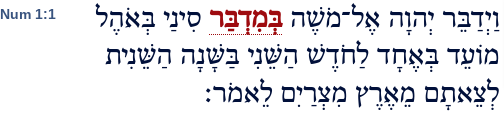
The Hebrew name for the Book of Numbers is מִדְבַּר (midbar), “wilderness.” It is transliterated as miḏbār, and pronounced mid-bawr'. The bet character בְּ which proceeds it is translated as “in.” בְּמִדְבַּר is phonetically pronounced "be’ mid-bawr'." This name literally means "in the wilderness." It is taken from the fifth word in the Book's first verse in Hebrew as illustrated above, describing the setting where the Biblical account takes place. In Jewish tradition, the Books of the Torah, the five books of Moses, and the first five Books of the Old Testament are known by their Hebrew names. The Books are known in English by their Greek-derived names, such as numbers in Christian Bibles.


The English Bible Book name "Numbers" comes from the Greek Septuagint and Latin Vulgate translations, which named the Book based on the census counts of the Israelites that appear in Chapters 1 and 26. Septuagint means "seventy" in Latin, referring to the traditional story that 70 (or 72) Jewish scholars translated. The Septuagint was written around 285-247 BCE, during the reign of Ptolemy II in Alexandria, Egypt, for the Jews in Alexandria, who had become more fluent in Greek than Hebrew.


Jehovah = "the existing One"


Jehovah is the proper name of the one true God. It is transliterated as Yᵊhōvâ, and phonetically pronounced yeh-ho-vaw’. In Jewish tradition it is translated as Adonai instead of Jehovah due to their respect for the holiness of God.


The original Hebrew Bible Westminster Leningrad Codex (WLC) version is available online at: https://www.blueletterbible.org/wlc/num/6/24-26/s_123024. The embedded video above will help you perfect your pronunciation of the Priestly Blessing.


The Hebrew language is written from the right side to the left, from the top down to the bottom. The Hebrew writing system primarily relies on consonants. In ancient Hebrew, only consonants were written, and readers were expected to supply the appropriate vowels based on context and knowledge.


The Masoretes devised a system of vowel notation known as niqqud. This system, using dots and dashes strategically placed above, below, or inside consonant letters to indicate vowel sounds, marked a pivotal moment in the history of the Hebrew language.


The Masoretic system, in addition to introducing niqqud, also brought about the use of cantillation marks for ritual chanting and punctuation. These marks are particularly useful in modern Hebrew, where niqqud is typically omitted in everyday writing. However, it remains a vital tool for poetry, children's literature, and religious texts, underscoring its practicality and relevance in contemporary times.


Sefer character: In the Hebrew Book of Bemidbar (Numbers), including Chapter 6, each verse is typically followed by a character that looks like a colon (:). This mark is called a sof pasuk (סוֹף פָּסוּק), which literally means "end of verse." It is not a letter but a cantillation mark used to indicate the end of a verse in the Hebrew Bible.


In Masoretic Hebrew the end of a verse appears as , with the sefer mark and the : cantillation mark.


Conclusion


The Priestly Blessing found in Numbers 6:24-26 is a powerful and enduring passage in both Jewish and Christian traditions. Its poetic structure and profound meaning have made it a cornerstone of religious blessings for millennia. The blessing beautifully encapsulates the desire for divine protection, grace, and peace. This journey through linguistics, history, and theology demonstrates the rich layers of meaning and tradition embedded in Biblical texts. It highlights the importance of understanding not just the words themselves, but also their cultural and historical context, as well as the intricacies of translation and interpretation. The Priestly Blessing continues to resonate with people of faith today, offering a timeless invocation of divine favor and peace. Its lasting impact is a testament to the enduring power of ancient wisdom and the universal human desire for blessing and protection.


The Significance of the Moon in Scripture

  The moon stands as one of the most visible and constant witnesses in the night sky to the creative power and ongoing providence of God. Sc...