Showing posts with label Hebrew. Show all posts

Thursday, August 8, 2024

Learn the Priestly Blessing in Hebrew "The LORD bless you and keep you..."


The Priestly Blessing found in Numbers 6:24-26, is one of the Bible's most revered and enduring passages. This ancient benediction, also known as the Priestly Blessing, invokes divine favor, protection, and peace. This comprehensive exploration delves into the rich tapestry of language, history, and theology surrounding this beloved text.

Our journey of exploration commences with the blessing itself, presented in its original Masoretic Hebrew, along with a transliteration and English translation. This unique approach allows us to delve into the blessing's poetic structure and profound meaning, both in its original form and in its contemporary understanding, sparking a sense of intrigue and engagement. 

From there, we embark on a fascinating exploration of Biblical scholarship, examining:

1. The Hebrew name of the Book of Numbers (Bemidbar) and its significance 
2. The origin of the English name "Numbers" and its connection to the Septuagint
3. The complexities of the divine name and its various translations
4. The intricacies of Hebrew writing, including its unique right-to-left script and consonantal system
5. The crucial contributions of the Masoretes in preserving and clarifying the Hebrew text

This introduction to the Priestly Blessing offers a linguistic analysis and a window into the rich cultural and historical context that has shaped our understanding of this timeless benediction. Whether you're a student, a person of faith, or simply curious about ancient texts, this exploration will deepen your appreciation of this revered passage and its enduring impact on religious tradition.

Masoretic Hebrew:


Transliteration:


Yevarechecha Adonai veyishmerecha

Ya'er Adonai panav elecha vichuneka

Yisa Adonai panav elecha veyasem lecha shalom


Transliteration converts Hebrew words into the Latin alphabet, allowing non-Hebrew speakers to approximate the pronunciation of Hebrew words. This conversion is necessary because Hebrew uses a different writing system with its own alphabet.

Key points about Hebrew transliteration:

1. It represents Hebrew sounds using familiar Latin letters.

2. The beauty of Hebrew transliteration lies in its adaptability. There are several transliteration systems, each with its own approach, but most aim to be phonetic, ensuring that the sounds of Hebrew are accurately represented in a familiar way.

3. Some Hebrew sounds don't have exact English equivalents, so conventions are used. For example, the letter "ח" (chet) is often transliterated as "ch" or "eh."

4. In the world of Hebrew transliteration, every detail matters. Vowels, often not written in pre-Masoretic Hebrew, are included in transliteration. This inclusion is crucial as it provides a more comprehensive understanding of Hebrew pronunciation, enriching the learning experience.

5. Stress marks, which are small lines placed above a vowel, may be added to indicate emphasized syllables. For example, in the transliteration of the Hebrew word 'מַטְרִיה' (mat-ri-ah), the stress mark is placed above the 'a' to indicate that this syllable is emphasized.

6. Names and common terms may have standardized English spellings that differ from strict transliteration. 'Strict transliteration' refers to a method that aims to represent the sounds of Hebrew words as accurately as possible in English, while 'standardized English spellings' are commonly used English versions of Hebrew words that may not reflect the exact pronunciation in Hebrew.

7. Academic transliteration may use additional symbols to represent Hebrew phonemes precisely.

Hebrew transliteration is not just a linguistic tool, but a gateway to a broader audience engaging with Hebrew texts and pronunciations. It allows individuals, even those without knowledge of the Hebrew alphabet, to explore the rich cultural and historical heritage embedded in Hebrew literature and language.

English translation:


May the LORD bless you and keep you

May the LORD make His face shine upon you and be gracious to you

May the LORD lift up His face toward you and give you peace


This blessing is found in Numbers 6:24-26. It is known as the Priestly Blessing or the Benediction.
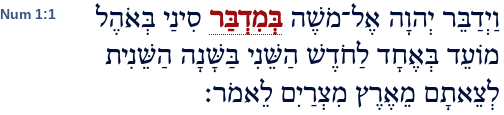


The Hebrew name for the Book of Numbers is מִדְבַּר (midbar), “wilderness.” It is transliterated as miḏbār, and pronounced mid-bawr'. The bet character בְּ which proceeds it is translated as “in.” בְּמִדְבַּר is phonetically pronounced "be’ mid-bawr'." This name literally means "in the wilderness." It is taken from the fifth word in the Book's first verse in Hebrew as illustrated above, describing the setting where the Biblical account takes place. In Jewish tradition, the Books of the Torah, the five books of Moses, and the first five Books of the Old Testament are known by their Hebrew names. The Books are known in English by their Greek-derived names, such as numbers in Christian Bibles.


The English Bible Book name "Numbers" comes from the Greek Septuagint and Latin Vulgate translations, which named the Book based on the census counts of the Israelites that appear in Chapters 1 and 26. Septuagint means "seventy" in Latin, referring to the traditional story that 70 (or 72) Jewish scholars translated. The Septuagint was written around 285-247 BCE, during the reign of Ptolemy II in Alexandria, Egypt, for the Jews in Alexandria, who had become more fluent in Greek than Hebrew.


Jehovah = "the existing One"


Jehovah is the proper name of the one true God. It is transliterated as Yᵊhōvâ, and phonetically pronounced yeh-ho-vaw’. In Jewish tradition it is translated as Adonai instead of Jehovah due to their respect for the holiness of God.


The original Hebrew Bible Westminster Leningrad Codex (WLC) version is available online at: https://www.blueletterbible.org/wlc/num/6/24-26/s_123024. The embedded video above will help you perfect your pronunciation of the Priestly Blessing.


The Hebrew language is written from the right side to the left, from the top down to the bottom. The Hebrew writing system primarily relies on consonants. In ancient Hebrew, only consonants were written, and readers were expected to supply the appropriate vowels based on context and knowledge.


The Masoretes devised a system of vowel notation known as niqqud. This system, using dots and dashes strategically placed above, below, or inside consonant letters to indicate vowel sounds, marked a pivotal moment in the history of the Hebrew language.


The Masoretic system, in addition to introducing niqqud, also brought about the use of cantillation marks for ritual chanting and punctuation. These marks are particularly useful in modern Hebrew, where niqqud is typically omitted in everyday writing. However, it remains a vital tool for poetry, children's literature, and religious texts, underscoring its practicality and relevance in contemporary times.


Sefer character: In the Hebrew Book of Bemidbar (Numbers), including Chapter 6, each verse is typically followed by a character that looks like a colon (:). This mark is called a sof pasuk (סוֹף פָּסוּק), which literally means "end of verse." It is not a letter but a cantillation mark used to indicate the end of a verse in the Hebrew Bible.


In Masoretic Hebrew the end of a verse appears as , with the sefer mark and the : cantillation mark.


Conclusion


The Priestly Blessing found in Numbers 6:24-26 is a powerful and enduring passage in both Jewish and Christian traditions. Its poetic structure and profound meaning have made it a cornerstone of religious blessings for millennia. The blessing beautifully encapsulates the desire for divine protection, grace, and peace. This journey through linguistics, history, and theology demonstrates the rich layers of meaning and tradition embedded in Biblical texts. It highlights the importance of understanding not just the words themselves, but also their cultural and historical context, as well as the intricacies of translation and interpretation. The Priestly Blessing continues to resonate with people of faith today, offering a timeless invocation of divine favor and peace. Its lasting impact is a testament to the enduring power of ancient wisdom and the universal human desire for blessing and protection.




Wednesday, February 7, 2024

Psalm 25: A Prayer Expressing Trust in the LORD!


Psalm 25, attributed to David in its superscription, is an intriguing piece of Biblical literature, both in its content and its form. This Psalm is classified as an individual lament, a genre within the Psalter where the author expresses sorrow, pleads for God's intervention, and often includes a confession of trust or praise. Unlike some Psalms where the historical context is explicitly stated (such as Psalm 51, which refers to David's sin with Bathsheba), Psalm 25 does not provide direct clues about the circumstances under which it was written. Scholars have speculated that it might have been composed during periods of great personal distress, possibly during the times David was pursued by Saul or Absalom.

Psalm 25

Here is Psalm 25 from the Bible in English:

1 To you, O LORD, I lift up my soul.

2 O my God, in you I trust; let me not be put to shame; let not my enemies exult over me.

3 Indeed, none who wait for you shall be put to shame; they shall be ashamed who are wantonly treacherous.

4 Make me to know your ways, O LORD; teach me your paths.

5 Lead me in your truth and teach me, for you are the God of my salvation; for you I wait all the day long.

6 Remember your mercy, O LORD, and your steadfast love, for they have been from of old.

7 Remember not the sins of my youth or my transgressions; according to your steadfast love remember me, for the sake of your goodness, O LORD!

8 Good and upright is the LORD; therefore he instructs sinners in the way.

9 He leads the humble in what is right, and teaches the humble his way.

10 All the paths of the LORD are steadfast love and faithfulness, for those who keep his covenant and his testimonies.

11 For your name’s sake, O LORD, pardon my guilt, for it is great.

12 Who is the man who fears the LORD? Him will he instruct in the way that he should choose.

13 His soul shall abide in well-being, and his offspring shall inherit the land.

14 The friendship of the LORD is for those who fear him, and he makes known to them his covenant.

15 My eyes are ever toward the LORD, for he will pluck my feet out of the net.

16 Turn to me and be gracious to me, for I am lonely and afflicted.

17 The troubles of my heart are enlarged; bring me out of my distresses.

18 Consider my affliction and my trouble, and forgive all my sins.

19 Consider how many are my foes, and with what violent hatred they hate me.

20 Oh, guard my soul, and deliver me! Let me not be put to shame, for I take refuge in you.

21 May integrity and uprightness preserve me, for I wait for you.

22 Redeem Israel, O God, out of all his troubles.

Psalm 25, is a poignant expression of trust, guidance, and plea for deliverance. It is a prayer that intertwines requests for protection and guidance with confessions of trust and faith in God.

Summary of Psalm 25

  1. Plea for Protection and Guidance: David begins by lifting his soul to God, expressing trust in Him, and seeking protection from shame and enemies.


  2. Request for Instruction: He asks God to teach him His ways and lead him in truth, highlighting a desire for spiritual and moral guidance.


  3. Confession of God’s Mercy and Faithfulness: David recalls God's mercy and steadfast love, acknowledging His goodness and righteousness.


  4. Prayer for Forgiveness: The psalmist pleads for forgiveness for the sins of his youth and his transgressions, emphasizing God's steadfast love and goodness as reasons for this mercy.


  5. Description of God’s Character: The Psalm describes God as good, upright, and a teacher to the humble, affirming that His paths are characterized by love and faithfulness.


  6. Personal Lament and Trust: David expresses his personal struggles, loneliness, and affliction, while continually reaffirming his trust in God’s deliverance.


  7. Prayer for Israel: The Psalm concludes with a prayer for the redemption of Israel from all its troubles, expanding the personal plea to a national level.

Theological Significance

  1. Trust in God: Psalm 25 exemplifies a profound trust in God amidst trials. This trust is not passive but active, involving a constant seeking of God’s guidance and a firm belief in His protection.


  2. God as Teacher and Guide: The Psalm highlights the theme of God as a teacher who instructs His followers in His ways. This teaching is not merely intellectual but deeply moral and spiritual, guiding believers in the path of righteousness.


  3. Divine Forgiveness and Mercy: The acknowledgment of personal sin and the plea for forgiveness are central to the Psalm. It underscores the theological concept of God’s readiness to forgive and His merciful nature, which is a recurrent theme in the Bible.


  4. Human Vulnerability and Divine Assistance: The Psalm reflects the human condition of vulnerability, loneliness, and distress, and it contrasts this with the divine response of assistance, guidance, and deliverance.


  5. The Righteous Character of God: The descriptions of God in the Psalm - good, upright, loving, faithful - contribute to the theological understanding of God’s character in the Judeo-Christian tradition.


  6. Comprehensive Appeal: The Psalm's acrostic structure, covering the entire Hebrew alphabet, can be seen as a metaphor for the comprehensive nature of the prayer - covering all aspects of life and human needs.


  7. Communal and Individual Dimensions: While the Psalm is a personal prayer, it concludes with a plea for the entire community of Israel, highlighting the interconnectedness of individual and communal faith in the biblical tradition.

Acrostic Nature of Psalm 25

One of the most distinctive features of Psalm 25 is its acrostic structure. In this Psalm, each verse begins with successive letters of the Hebrew alphabet. This stylistic choice is more than a mere literary device; it serves several purposes:

  1. Memorization: The acrostic pattern aids in memorization, which was crucial in a time when oral tradition was predominant.


  2. Completeness: Using the entire alphabet may symbolize a sense of completeness or thoroughness in the prayer or message.


  3. Artistic Expression: It demonstrates a high level of skill and creativity in the composition, reflecting the depth and intensity of the psalmist's feelings.

To illustrate, here are the first few verses of Psalm 25 in Hebrew, demonstrating the acrostic pattern:

  • Aleph (א): אֵלֶיךָ יְהוָה נַפְשִׁי אֶשָּׂא ("To you, O LORD, I lift up my soul.")
  • Bet (ב): בּוֹטֵחַ אָנִי בָךְ ("O my God, in you I trust;")
  • Gimel (ג): גֵּל עֵינַי וְרָאוּ ("Make me to know your ways, O LORD;")
Notice that Aleph, Bet, and Gimel are the first three characters of the Hebrew Alphabet (Alef-Bet).

Content and Themes of Psalm 25

Psalm 25 expresses a range of emotions and requests. It shows David's trust in God, his plea for guidance and forgiveness, and his desire for protection against enemies. The penitential aspect of the psalm, where David confesses his sins and seeks forgiveness, might suggest a connection to events like his transgression with Bathsheba. However, the lack of specific references leaves this open to interpretation.

Comparison with Other Acrostic Psalms

The use of acrostic patterns is not unique to Psalm 25 in the Book of Psalms. This structure appears in several other Psalms, each with its own thematic and stylistic nuances:

  • Psalms 9 and 10: These Psalms are sometimes considered a single acrostic poem. They depict a picture of God's judgment on the wicked and deliverance of the righteous.


  • Psalm 34: This is an acrostic Psalm of thanksgiving and praise, reflecting on God’s deliverance and blessings.


  • Psalm 37: An acrostic wisdom Psalm advising trust in God and a righteous way of life.


  • Psalms 111 and 112: These are companion Psalms, both acrostic, praising God for His works and the blessedness of the righteous.


  • Psalm 119: The longest chapter in the Bible, this acrostic Psalm is a meditation on the beauty and importance of God’s law.


  • Psalm 145: A Psalm of praise, celebrating God’s greatness and kindness.

Conclusion

Psalm 25, with its acrostic structure and heartfelt content, offers a glimpse into the complexity and depth of Biblical poetry. It reflects a range of human emotions - from distress to trust and from confession to hope. The use of the acrostic form not only showcases the literary skill of the author but also serves to enhance the memorability and impact of the Psalm’s message. While the specific historical context of Psalm 25 may remain uncertain, its themes of trust in God, plea for guidance, and acknowledgment of personal failings are universally relatable, making it a timeless piece of spiritual literature.

Is God Calling You to Generosity?

  Many of us have rhythms in our spiritual lives that prepare us for generosity. Their Sunday habit required an intentional readiness for ge...


