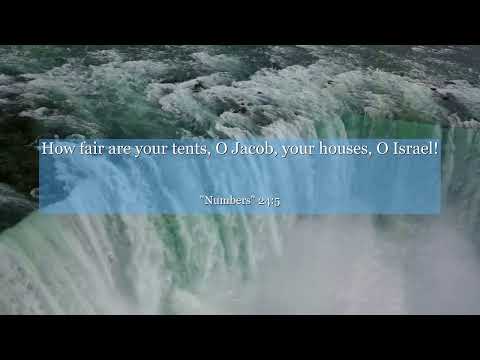
“How beautiful are your tents, Jacob, your dwelling places, Israel!” (Numbers 24:5, ESV).
The Hebrew text of this verse reads: מָה־טֹּבוּ אֹהָלֶיךָ יַעֲקֹב מִשְׁכְּנֹתֶיךָ יִשְׂרָאֵל׃. These words form one of Scripture’s most striking declarations of divine perspective. Spoken by the pagan prophet Balaam under the compulsion of the Spirit of God, the line captures a reality that human eyes frequently miss. King Balak of Moab viewed the Israelite camp as an existential threat and paid handsomely to have it cursed. Instead, every attempt at cursing became an escalating series of blessings that celebrated the beauty, order, and covenant security of God’s people. The episode reveals a consistent biblical pattern: the world often evaluates God’s people through lenses of threat, failure, or appearance, while the Lord Himself perceives them through the unchanging categories of covenant love, redemptive purpose, and indwelling presence.
This spiritual blog post explores that contrast by examining the historical setting, offering a detailed exegesis of the Hebrew in Numbers 24:5, unfolding the wider oracle in Numbers 24:3-9, and drawing out theological and practical implications for believers today. The goal is to help readers align their vision more closely with the Lord’s own view of His people, even when circumstances or human opinion suggest otherwise.
The Historical and Literary Context of Balaam’s Oracles
The narrative of Numbers 22–24 unfolds on the plains of Moab as Israel prepares to enter the land of promise. Balak, terrified by reports of Israel’s victories over Sihon and Og, sent messengers to summon Balaam son of Beor, a renowned diviner whose curses were believed to carry supernatural force. Balak’s explicit request was straightforward: “Come now, curse this people for me, since they are too mighty for me. Perhaps I shall be able to defeat them and drive them from the land” (Numbers 22:6, ESV).
What followed demonstrated God’s absolute sovereignty over human intentions. Despite Balaam’s initial willingness and later attempts to manipulate the outcome through ritual and vantage point, the Spirit of God repeatedly overrode the prophet’s words. The first two oracles (Numbers 23:7-10, 18-24) already frustrated Balak’s purpose. By the third oracle in Numbers 24:3-9, the reversal reached its climax. Each successive message grew stronger in its affirmation of Israel and more pointed in its rebuke of anyone who would oppose them.
The literary structure reinforces the theological point. Balaam’s oracles are poetic, employing parallelism, vivid imagery, and deliberate escalation. The narrator notes that Balaam “saw Israel camping tribe by tribe” and that “the Spirit of God came upon him” (Numbers 24:2, ESV). The visual impression of ordered tents around the central tabernacle became the occasion for a Spirit-inspired declaration of beauty and blessing. Human schemes for harm were transformed into public testimony of divine faithfulness. As the user-supplied notes observe, each oracle made Balak’s position progressively worse: the first failed to curse, the second actively blessed, and the third placed a curse upon the curser himself.
This progression illustrates a broader biblical truth. Opposition to God’s people, whether visible or hidden, cannot ultimately succeed because it collides with the irrevocable commitments the Lord made to the patriarchs. The story also highlights the hiddenness of much of God’s activity. Israel camped in the wilderness unaware of Balak’s consultations or Balaam’s mountaintop struggles. Yet the Lord was already at work on their behalf, protecting them from dangers they could not see and advancing purposes they could not yet imagine.
Exegeting the Hebrew of Numbers 24:5
A careful examination of the original language uncovers layers of meaning that the English translation “How beautiful are your tents, Jacob, your dwelling places, Israel!” only partially conveys. Each key term contributes to the overall portrayal of divine perspective.
The opening exclamation מָה (mah) functions here not as a question but as an exclamation of wonder, comparable to its use in Genesis 28:17 when Jacob declared, “How awesome is this place!” The construction signals that what follows exceeds ordinary description.
The verb טֹּבוּ (tovu) derives from the root טוֹב (tov), which encompasses goodness that is both moral and aesthetic, pleasant, fitting, beneficial, and beautiful. In Genesis 1, God repeatedly declares His creation “good” (tov) after evaluating its order and purpose. Here, the same term describes the Israelite camp. The goodness Balaam perceives is not merely decorative; it reflects harmony, proper arrangement, and alignment with divine intention. The tents are “good” because they embody the order the Lord Himself established when He organized the tribes around the tabernacle (Numbers 2). What Balak feared as chaotic hordes appeared to the inspired prophet as a beautifully ordered community.
אֹהָלֶיךָ (ohaleikha), “your tents,” refers to the portable dwellings of the wilderness generation. In the ancient Near East, tents signified transience and vulnerability. Yet the Lord pronounces them beautiful. The choice of this word underscores that God does not require permanent structures or impressive architecture to delight in His people. The very signs of their pilgrim status, the vulnerability of wilderness life, become the canvas on which divine beauty is displayed. Some later Jewish interpretation connected “tents” with houses of study and prayer, seeing in the verse a celebration of communal spiritual life. While the primary reference remains the literal encampment, the broader canonical trajectory supports the idea that God treasures the gathered life of His people wherever they dwell in dependence upon Him.
The parallel term מִשְׁכְּנֹתֶיךָ (mishkenoteikha), “your dwelling places,” carries even richer theological resonance. The root שָׁכַן (shakan) means “to dwell” or “to abide.” The related noun מִשְׁכָּן (mishkan) designates the tabernacle, the portable sanctuary that symbolized God’s presence in the midst of Israel. By using this term for the people’s own dwellings, the oracle suggests that the beauty of the camp derives from the reality that the Lord Himself tabernacles among them. The Shekinah glory that rested over the tabernacle at the center of the camp radiated outward, rendering the entire community a dwelling place of divine presence. The tents are beautiful, not because of their material quality, but because they house a people indwelt by the living God.
The names יַעֲקֹב (Yaʿaqov) and יִשְׂרָאֵל (Yisraʾel) appear in poetic parallelism. Jacob recalls the patriarch whose name was changed after wrestling with God. Israel emphasizes the corporate identity forged through covenant and redemption from Egypt. The pairing affirms continuity between the individual ancestor and the nation that bears his transformed name. God sees the people not as a nameless mass but as the fulfillment of promises made to the fathers. The parallelism also hints at the tension and grace inherent in that identity: the same people who strive with God remain the objects of His electing love.
Taken together, the verses present a comprehensive reorientation of vision. Where human observers might register only tents in a desert, temporary, dusty, and militarily threatening, God declares beauty rooted in order, presence, and covenant relationship. The exegetical details confirm that this beauty is not sentimental but substantive, grounded in the Lord’s own character and prior redemptive acts.
Abundance, Strength, and Irrevocable Blessing
Numbers 24:3-9 expands the single exclamation of verse 5 into a panoramic vision. After the introductory formula identifying Balaam as one whose eyes have been opened and who hears the words of God, the oracle paints Israel with a series of vivid images.
The people are “like valleys that stretch out, like gardens by the riverside, like aloes planted by the Lord, like cedars beside the waters” (Numbers 24:6, ESV). These metaphors evoke fertility, fragrance, stature, and rootedness by a life-giving source. Valleys suggest expansive blessing rather than confinement. Gardens beside rivers imply cultivation and fruitfulness in a land that humanly appeared barren. Aloes, prized for their aromatic wood and durability, evoke enduring fragrance and value. Cedars, symbols of majesty and strength in the ancient world, stand tall when planted beside abundant water. The cumulative effect transforms the wilderness wandering into a preview of settled prosperity under divine care.
The oracle continues with images of strength and future dominion: water poured from buckets, seed in many waters, a king higher than Agag, and a kingdom exalted. Israel’s God “brings him out of Egypt” with strength “like a wild ox” (reʾem, a powerful, untamable bovine known for its ferocity). The people will “consume the nations” and “break their bones,” yet they also “bow down… as a lion” who cannot be roused (Numbers 24:8-9, ESV). The lion imagery conveys regal security rather than mere aggression; the lion rests because none dares disturb it.
The oracle closes with the Abrahamic formula: “Blessed is he who blesses you, and cursed is he who curses you” (Numbers 24:9, ESV; cf. Genesis 12:3; 27:29). This inclusion is decisive. The blessing pronounced over Israel is not a new invention but the continuation of the covenant sworn to Abraham. Balak’s attempt to curse what God has blessed collides directly with that foundational promise. As the supplied notes indicate, each oracle worsened Balak’s situation until the final line placed him under the very curse he sought to inflict.
The full oracle, therefore, moves from present beauty (v. 5) to future abundance and unassailable strength, all anchored in the Lord’s prior commitment. God sees not only what His people are in the wilderness but what He intends them to become. The perspective is eschatological as well as present; it encompasses both the immediate camp and the long trajectory of redemptive history.
Divine Perspective versus Human Perspective
The contrast between Balak’s fear and Balaam’s inspired vision models a perennial tension. Human evaluation tends to focus on visible threats, numerical strength, or apparent disorder. Balak counted Israel’s numbers and saw danger. Modern observers may count attendance, budget shortfalls, or cultural influence and reach similar conclusions of weakness or threat. Yet the Lord consistently evaluates His people according to different criteria.
One angle is covenantal. God’s view is shaped by the promises He Himself made rather than by the people’s current performance. Israel had grumbled, rebelled, and doubted repeatedly, yet the oracle contains no mention of these failures. The blessing rests on the Lord’s faithfulness, not Israel’s perfection. This does not minimize sin or discipline; later chapters record both, but it does establish the foundational lens through which God regards His covenant people.
A second angle is relational and indwelling. The beauty of the tents derives ultimately from the presence of God at their center. The same principle operates in the New Testament church. Believers are “a dwelling place for God by the Spirit” (Ephesians 2:22, ESV). The gathered community, however imperfect its outward form, possesses a beauty that the world cannot perceive because it lacks the category of divine indwelling. Critics may focus on scandals, divisions, or cultural irrelevance; the Lord sees living stones being built into a spiritual house (1 Peter 2:5).
A third angle concerns hidden activity and spiritual opposition. Israel remained unaware of Balak’s schemes and Balaam’s mountaintop negotiations. God was nevertheless protecting and advancing His purposes. Contemporary believers and congregations likewise face unseen opposition, spiritual, relational, or institutional, yet the same Lord who turned curses into blessings continues to guard what He has planted. This reality invites trust rather than anxiety and prayer rather than despair when plans appear thwarted.
Nuances and edge cases deserve acknowledgment. The blessing pronounced here is corporate and covenantal; it does not guarantee individual immunity from suffering or judgment. Israel later experienced discipline for unfaithfulness at Peor (Numbers 25). Similarly, local churches or individual Christians may undergo seasons of apparent barrenness or attack without contradicting God’s ultimate commitment. The oracle does not promise the absence of struggle but assurance that no opposition can nullify the Lord’s purposes. Another nuance concerns Balaam himself. Though used powerfully, his heart remained divided (Numbers 22:18-21; 2 Peter 2:15; Jude 11). God can sovereignly employ even compromised instruments while remaining untainted by their motives. This warns against assuming that gifted speech or apparent blessing automatically validates the speaker’s heart.
Canonical trajectories enrich the picture. The “star” and “scepter” of Numbers 24:17 point forward to a royal figure from Jacob’s line who will ultimately defeat all enemies. Christian readers rightly see here a foreshadowing of the Messiah, in whom the tension between curse and blessing finds its resolution (Galatians 3:13-14). The beauty of the tents anticipates the greater beauty of the church, Christ’s bride, and the new creation, the ultimate dwelling place of God with humanity (Revelation 21:1-4).
The Practical Implications of Unseen Faithfulness
The Balaam narrative repeatedly emphasizes that God works on behalf of His people even when they cannot perceive it. Balak’s conversations with Balaam occurred at a distance; Israel camped in apparent vulnerability. Yet every scheme was intercepted and reversed. This pattern encourages believers facing criticism, uncertainty, or spiritual opposition to remember that visible circumstances do not exhaust reality. The Lord who protected Israel from an enemy they did not know continues to protect His people from dangers they cannot see.
For those in positions of spiritual leadership, the passage offers a needed reorientation. It is easy to fixate on metrics of apparent strength or weakness, attendance trends, giving patterns, or cultural engagement, and to conclude that the “tents” are either impressive or inadequate. Numbers 24 invites leaders to cultivate the habit of viewing the people of God through the lens the Lord Himself uses: ordered around His presence, beautiful because of a covenant relationship, and destined for purposes that extend far beyond present limitations. Such a vision does not ignore problems or sin; it refuses to allow problems or sin to become the dominant category of evaluation.
Practical steps flow naturally. Regular reflection on moments when God’s protection or provision operated unseen cultivates gratitude and trust. Corporate worship that centers on the Lord’s presence rather than solely on visible outcomes reinforces the truth that the beauty of the “tents” derives from the One who dwells among His people. When opposition arises, whether from external critics or internal conflict, the story of Balak and Balaam provides language for prayer: the Lord, who turns curses into blessings, remains able to accomplish His purposes despite every obstacle.
The closing line of the oracle supplies both warning and promise. Those who bless God’s people align themselves with the Lord’s own commitments; those who persist in cursing place themselves under divine opposition. In an age of polarized discourse and easy criticism, this word retains sharp relevance. Blessing the people God has blessed is not optional sentimentality but participation in the divine perspective.
Conclusion
Numbers 24:5 and its surrounding oracle confront readers with a fundamental choice of vision. Balak saw a threat to be eliminated. Balaam, under divine compulsion, saw tents and dwelling places that were beautiful because the Lord had chosen, redeemed, and indwelt them. The same contrast applies whenever God’s people are evaluated by outsiders, leaders, or the people themselves. Failures, limitations, and wilderness seasons are real, yet they do not define the ultimate reality. God sees His people through the lens of covenant faithfulness, indwelling presence, and irrevocable purpose.
The invitation of this passage is therefore both humbling and liberating. Humbling, because human assessments of beauty, strength, and significance prove repeatedly inadequate. Liberating, because the Lord’s evaluation cannot be overturned by human schemes, personal failures, or hidden opposition. The God who declared the wilderness camp beautiful continues to look upon His people with the same eyes of covenant love.
May you learn to thank Him for unseen faithfulness, to walk forward with confidence in promises that cannot fail, and to view one another increasingly as the Lord Himself views His own: beautiful tents and dwelling places because the Beautiful One has chosen to make His home among them.