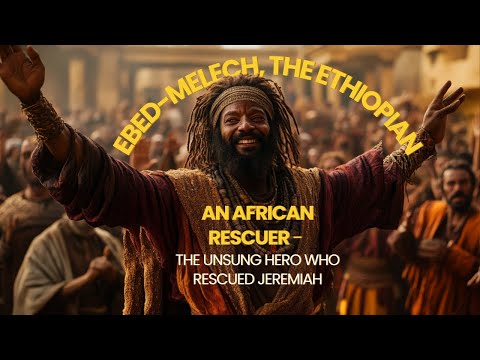
When the Lord’s faithful servants suffer for righteousness, He often sends them direct words of comfort. At times, He also sends special assurances to those who risk much to stand with them. Ebed-melech, an Ethiopian official in Zedekiah’s court, showed precisely this kind of costly compassion to Jeremiah. Though he was a foreigner and a court eunuch, socially marginalized in Israelite society, his courageous intervention on the prophet's behalf moved God's heart. The result was one of the most tender personal promises in the book of Jeremiah.
The story begins in the dark, muddy בּוֹר (bôr) of Jeremiah 38. This Hebrew word, usually rendered “cistern” or “pit,” describes a large, bottle-shaped underground reservoir carved out of rock to collect rainwater. When dry, such cisterns became convenient dungeons. Jeremiah 38:6 records that the officials “took Jeremiah and cast him into the cistern of Malchiah the king’s son… and they let Jeremiah down by ropes. And there was no water in the cistern, but only טִיט (ṭîṭ), and Jeremiah sank in the טִיט.” The term טִיט denotes thick, sticky clay or mire. The verb וַיִּטְבַּע (wayyiṭbaʿ) from the root טָבַע (ṭābaʿ) means “to sink down” or “to be submerged.” Jeremiah did not merely stand in shallow mud; he sank into it, exhausted, cold, and facing slow death by starvation or exposure. The בּוֹר had become a living tomb.
This was not Jeremiah’s first pit. Earlier in his ministry, he had cried out in language that echoes Psalm 40:2, where the psalmist praises God for drawing him “up from the pit of destruction, out of the miry bog.” The physical and spiritual parallels are deliberate. Jeremiah experienced the visceral reality of being abandoned by his own people for speaking the word of the Lord. The princes viewed his calls to surrender to Babylon as treason. In reality, Jeremiah was urging the only path that could spare the city from the full fury of the Babylonian siege. His message was unwelcome, so the powerful silenced him in the most degrading way possible.
Into this scene of calculated cruelty stepped an unlikely deliverer. Jeremiah 38:7 introduces עֶבֶד־מֶלֶךְ (ʿEbed-melekh) הַכּוּשִׁי (hakkûšî). The first name means “servant of the king,” a common court title. The second identifies him as a כּוּשִׁי, a Cushite from the region south of Egypt, modern Ethiopia, and Sudan. He is further described as a סָרִיס (sārîs), a term that can mean either “eunuch” or “high official.” In the ancient Near East, many royal servants in sensitive positions were castrated; the word therefore carries both functional and social weight. Ebed-melech was a Black African, a Gentile, and quite possibly a eunuch, three strikes against full inclusion in Israelite religious life (see Deuteronomy 23:1). Yet this outsider became the instrument of Jeremiah’s salvation.
Upon hearing what had been done, Ebed-melech went directly to King Zedekiah as the king sat at the Benjamin Gate. His plea in Jeremiah 38:9 is remarkably bold: “My lord the king, these men have done evil in all that they did to Jeremiah the prophet by casting him into the cistern.” He did not whisper in private chambers; he confronted the situation publicly. The weak king, who had earlier yielded to the princes, now gave Ebed-melech authority and thirty men to effect the rescue.
The details of the actual extraction reveal both practicality and genuine care. Ebed-melech went “to the wardrobe of the king” and brought out בְּלוֹאֵי סְחָבוֹת וּבְלוֹאֵי מְלָחִים, old rags and worn-out clothes. These tattered, cast-off garments were lowered to Jeremiah with instructions to place them “under your armpits” between his body and the ropes. The ropes themselves (חֲבָלִים, ḥăbālîm) would have cut deeply into flesh already weakened by hunger and exposure. By padding them, Ebed-melech prevented additional injury. This was not minimal compliance; it was thoughtful mercy. The prophet was lifted out of the בּוֹר and placed in the court of the guard, a significant improvement, though still a form of confinement.
God did not forget the man who had risked everything for His prophet. While Jeremiah remained in the court of the guard, “the word of the LORD had come to Jeremiah” with a message specifically for Ebed-melech (Jeremiah 39:15-18). The timing is significant. Jerusalem’s fall was imminent. The Babylonian army was at the gates. In the middle of a national catastrophe, the Lord paused to address one faithful Gentile by name.
The message begins with solemn confirmation of judgment: “Behold, I will bring My words upon this city for adversity and not for good, and they shall be performed in that day before you” (v. 16). The Hebrew construction emphasizes certainty. God’s earlier warnings through Jeremiah would now be fulfilled in full view of Ebed-melech. Yet the very next word is “But” (v. 17). National judgment does not cancel personal mercy.
The core promise uses two powerful Hebrew verbs of deliverance. First, וְהִצַּלְתִּיךָ (vehiṣṣaltîḵā) from the root נָצַל (nāṣal). In the Hiphil stem this verb means to snatch away, to rescue by force, to strip someone out of the hand of an enemy. It carries the image of violent extraction from danger. God promises to perform for Ebed-melech the very action Ebed-melech had performed for Jeremiah, pulling him out of mortal peril.
The promise intensifies in verse 18: “For I will surely deliver you, and you shall not fall by the sword, but your life shall be as a prize to you, because you have put your trust in Me, declares the LORD.” The emphatic construction מַלֵּט אֲמַלֵּטְךָ (mallēṭ ʾămallēṭḵā) repeats the root מָלַט (mālaṭ) in infinitive absolute plus imperfect. This grammatical pattern in Hebrew expresses absolute certainty: “Delivering, I will deliver you.” There will be no doubt, no slippage, no last-minute failure.
The most striking phrase is “your life shall be as a prize to you.” In Hebrew this is וְהָיְתָה לְךָ נַפְשְׁךָ לְשָׁלָל (vehāyṯâ leḵā nap̄šəḵā lešālāl). The word נֶפֶשׁ (nephesh) here means “life” or “person” in its totality. שָׁלָל (šālāl) is the plunder or booty taken by a victorious army. In ancient warfare, soldiers risked death precisely to gain שָׁלָל, valuable goods they could carry home. God reverses the imagery. Ebed-melech will not lose his life in the chaos of invasion and slaughter. Instead, his own נֶפֶשׁ will become his שָׁלָל, the prize he carries safely through the battle. He will emerge from the fall of Jerusalem with his life intact, as though he had won a great victory.
The ground of this promise is explicitly relational and theological: “because you have put your trust in Me.” The verb is בָטַחְתָּ (bāṭaḥtā) from בָּטַח (bāṭaḥ). This is not mere intellectual agreement; it describes a confident, secure reliance upon Yahweh even when human power structures threatened retaliation. Ebed-melech feared the princes, “the men of whom you are afraid” (v. 17, from the root גּוּר, gûr, “to dread”). Yet his fear of man did not paralyze his obedience. His trust in God proved stronger than his fear of powerful officials. The act of rescue flowed from that deeper trust.
Commentators have long noted what the promise does not mention. It says nothing of Ebed-melech’s courage, his resourcefulness with the rags, or the political risk he accepted. It highlights only his trust. As one scholar observed, the mainspring of his remarkable deed was faith in the God of Israel. On the eve of Judah’s collapse, a Gentile man entered into living union with that God through trust. This moment is profoundly prophetic. It anticipates the day when the gospel would go to the nations and when those formerly excluded, eunuchs, foreigners, the marginalized, would be welcomed on the basis of faith (Isaiah 56:3-5).
The promise also reveals God’s sovereignty over human rage. The Lord declares that Ebed-melech will not be handed over to the very men whose vengeance he feared. Human power is real, but it is never ultimate. As the earlier devotional reflection noted, God “puts a bit into the mouth of rage, and a bridle upon the head of power.” No one can ultimately harm the servant of the Lord without divine permission. Ebed-melech’s life was hidden in the greater purposes of Yahweh.
What does this ancient story say to believers today? First, it dignifies every act of mercy shown to those who suffer for truth. Jesus Himself taught that giving even a cup of cold water to a prophet in the name of a prophet receives a prophet’s reward (Matthew 10:41-42). Ebed-melech gave far more than a cup of water; he gave time, reputation, political capital, and physical effort. God noticed. He sent a personal message through the very prophet who had been rescued.
Second, the story encourages those who feel like outsiders. Ebed-melech was not an Israelite, not a priest, not a prophet. He was a Black African eunuch serving in a foreign court. Yet the Lord addressed him by name and gave him a promise of preservation. God is not impressed by pedigree or position. He looks for trust that expresses itself in courageous compassion.
Third, it speaks to the fear many feel when standing with unpopular truth-tellers. Cultural or institutional pressure can be intense. The “princes” of our day may threaten reputation, employment, or relationships. Ebed-melech was afraid too. The promise does not rebuke his fear; it simply overrides it with a greater reality: “I will deliver you… because you have put your trust in Me.” Trust does not eliminate fear; it moves us to act despite fear.
Fourth, the narrative reminds us that God often works through secondary agents. Jeremiah’s deliverance from the בּוֹר required human hands, ropes, and old rags. Yet behind those hands stood the sovereign Lord, who had already determined to rescue both the prophet and the rescuer. We should never despise the practical, even messy, ways God answers prayer, through people willing to get dirty for the sake of righteousness.
Finally, the story offers hope amid larger judgments. Jerusalem fell. Many died. The temple was destroyed. Yet one man who trusted God and helped His servant survived with his life as a prize. In seasons when entire cultures or institutions seem to be collapsing, the Lord still knows how to mark out individuals for preservation. His judgments are never indiscriminate, and His mercy never fails those who trust Him.
Ebed-melech disappears from the biblical record after this promise. We do not know whether he lived out his days in Judah or was taken to Babylon. What matters is that God kept His word. The Cushite who pulled a mud-covered prophet from a cistern received from the Lord the same kind of deliverance he had extended: life rescued, life preserved, life honored.
May we learn from his example. When we see brothers and sisters sinking in the muddy pits of persecution, cancellation, or despair, may we be willing to use whatever resources we have, our voice, our position, our time, even our old rags, to lift them out. And may we do so not to earn favor, but because we trust the God who sees every such act and who promises that no faithful kindness shown to His servants will ever be forgotten.
The Lord who delivered Jeremiah through Ebed-melech and then delivered Ebed-melech because of his trust remains the same today. He still pulls His people from miry pits. He still rewards those who fear Him more than they fear powerful men. And He still sends personal words of assurance to those who stand with His suffering servants. In the end, their life and your life will be to you as a prize, because you have put your trust in Him.



No comments:
Post a Comment